Psychological evaluation is a structured process. A licensed psychologist gathers history, observational data, standardized testing results, and collateral information. The goal is to answer one specific referral question. In legal work, that question is usually emotional damages, parental fitness, cognitive disability, risk of future harm, or a defendant's mental state. The output is a written report, not a diagnosis alone.
Lawyers, judges, and adjusters often meet psychological evaluations at a pivotal moment: when a claim hinges on whether an injury caused lasting emotional harm, or when a custody case reveals how a parent handles stress in front of a child.
The term "evaluation" gets used loosely within the legal system. A therapist's progress note, a school screening, and a court-ordered forensic battery may all be referred to as an evaluation, yet they carry very different weight in a trial setting.
The guide below aims to provide clarity on what an evaluation covers and how the process runs on a calendar. It also covers the ethical guidelines that govern the work and shape what a report can properly conclude.
What Is a Psychological Evaluation, Really?
A psychological evaluation draws on evidence from multiple sources and connects those findings for the purpose of forming a diagnostic conclusion. Every claim in the report should be grounded in verifiable data about the examinee and supported by up-to-date literature.
Three data streams feed a sound psychological assessment: records, interviews, and testing. Records supply history that memory distorts, and they reveal patterns of behavior. A clinical interview adds context through appropriate questioning and behavioral observation, while collateral interviews provide other perspectives. Standardized tests then compare the individual to a normed group, which places the finding on a scale another psychologist can independently score and check.
The referral question drives the evaluation procedures and the focus of the outcome. In a tort case, "Does this claimant meet criteria for PTSD because of the collision?" produces a focused battery. "Does this person have PTSD?" is likely irrelevant to the legal question, because it does not connect the finding to the case.
Who Conducts Psychological Evaluations?
Licensed psychologists are typically best suited for completing psychological evaluations. When an evaluation involves psychology and the law, this is generally considered a forensic case, and the psychologist should hold forensic training relevant to the referral question. A general license alone does not establish competence to opine on competency to stand trial or on parental fitness. The APA Specialty Guidelines for Forensic Psychology describe what does.
Psychiatrists are medical providers who can confidently speak to and prescribe necessary psychotropic medication. That is often the primary treatment for people with serious and persistent mental illness. Many psychiatrists do not receive the forensic training that would support psychometric testing, but their opinion on progress, restorability, and future treatment planning is essential.
Neuropsychologists receive specialized training in the relationship between brain functioning and behavior. They often work with people who have experienced brain injury, such as a TBI, or decline, such as dementia, and assess it through extensive batteries. Their focus usually sits with neurocognitive domains: executive functioning, attention, and memory. Neuropsychologists also tend to show an advanced understanding of how to integrate medical information such as brain imaging.
School psychologists typically focus on learning capacity, whether disability or giftedness, within the school system, and provide various levels of therapy for students in need. The relevant testing often assesses intellect, achievement, and behavior that is either consistent or different between home and school. Their role frequently includes therapy and acting as an interdisciplinary lead on IEPs, 504 plans, and similar processes.
Before retaining a mental health professional for a forensic case, ask what forensic training they have completed, how their experience maps onto your specific referral question, and whether they have testified on that question before. An evaluator should be able to state the limits of their own competence without hesitation.
When a Matter Calls for an Evaluation
A forensic psychological evaluation is warranted when mental health symptoms may influence the outcome of a case. Within the legal system, that can include an injury plaintiff claiming emotional damages, a parent in a contested custody case, and a defendant with mitigation or risk-assessment needs.
Outside court, evaluations serve families, schools, and the wider community. A child who struggles academically may benefit from assessment for a neurodevelopmental or learning disability. An adult whose treatment has stalled may improve with diagnostic clarity. Employers also request evaluations for safety-sensitive roles. Those fitness-for-duty checks follow tighter rules than typical clinical work, and the employer usually receives a fitness recommendation and an outline for success rather than the clinical findings themselves.
Explaining the Process to Your Client
Examinees often resist evaluation because they expect a verdict on their character. What an evaluation produces is a description of current functioning, strengths, and areas of need, tied to the referral question. A diagnosis is shorthand for a pattern, not a fixed identity. Two people carrying the same label can differ widely in daily behavior, judgment, and skill.
An evaluation can also name a condition that had not yet been identified, or bring order to a history of conflicting diagnoses collected over many years.
Counsel can reduce a client's anxiety by describing the process accurately. The psychologist asks about background history, such as what it was like growing up, and about current day-to-day functioning, such as sleep, mood, and relationships, and administers testing as the referral question requires. The examinee is told at the outset who the client is and what the limits of confidentiality are.
Describing the process is not coaching. Nothing here is guidance on how an examinee should answer.
What to Expect at Every Step
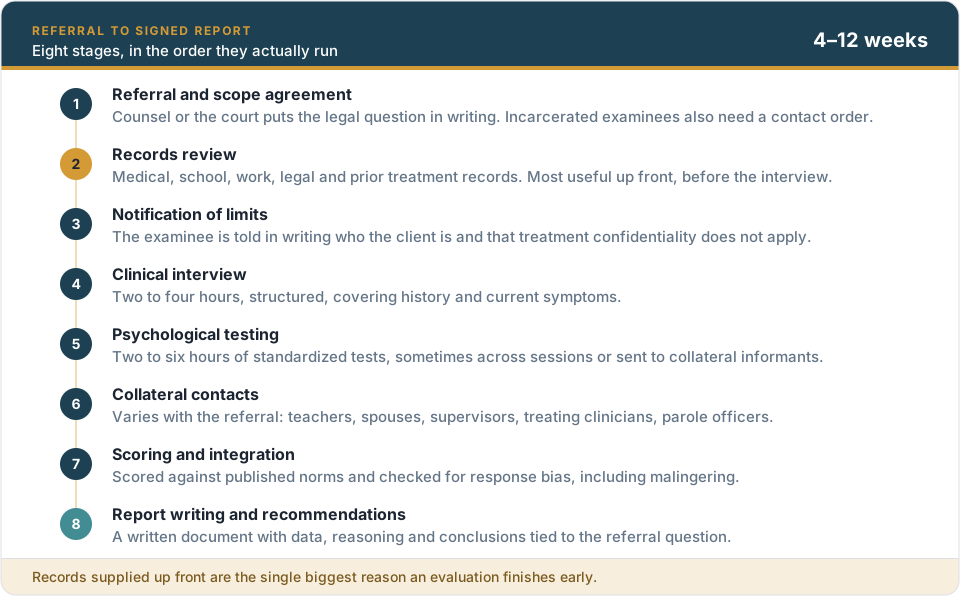
A typical forensic evaluation can take anywhere from four to twelve weeks. The steps below show how the work runs in practice. Of note, the process is usually expedited when information is readily available to the psychologist.
- 1Referral and scope agreement. Counsel or the court provides the legal question in writing. If the individual is incarcerated, a contact order is often necessary.
- 2Records review. Medical, school, work, legal, and prior treatment records. Most helpful when available up front, as it assists the evaluator in preparing for the interview.
- 3Notification of limits. The examinee is informed in writing who the client is, what the evaluation is for, and that the confidentiality protections of treatment do not apply here.
- 4Clinical interview. Two to four hours, structured, covering history and current symptoms.
- 5Psychological testing. Two to six hours of standardized tests, sometimes administered across sessions or provided to collateral informants.
- 6Collateral contacts. This varies with the referral, and can include teachers, spouses, supervisors, treating clinicians, and parole officers.
- 7Scoring and integration. Test results are scored alongside researched norms and assessed for response bias, including malingering.
- 8Report writing and recommendations. A written document with data, reasoning, and conclusions tied to the referral question.
The Initial Consultation
The first consultation is a meeting with counsel to discuss the referral and set expectations, and it usually runs fifteen to twenty minutes. Bring the court order, discovery material, and any other available records. The psychologist reviews the referral question, states the fees, and confirms what the report can and cannot cover. The examinee is typically not present. Confidentiality here is limited and defined by the referral rather than by a treatment relationship, and the examinee receives that notice separately at step three.
This phase specifies the scope. Say counsel asks for an opinion on violence risk and later requests an added opinion on parental fitness. That second opinion falls outside what was assessed, and offering it would be improper. It would require a second evaluation with a different referral question.
Clinical Intake vs. Forensic Evaluation
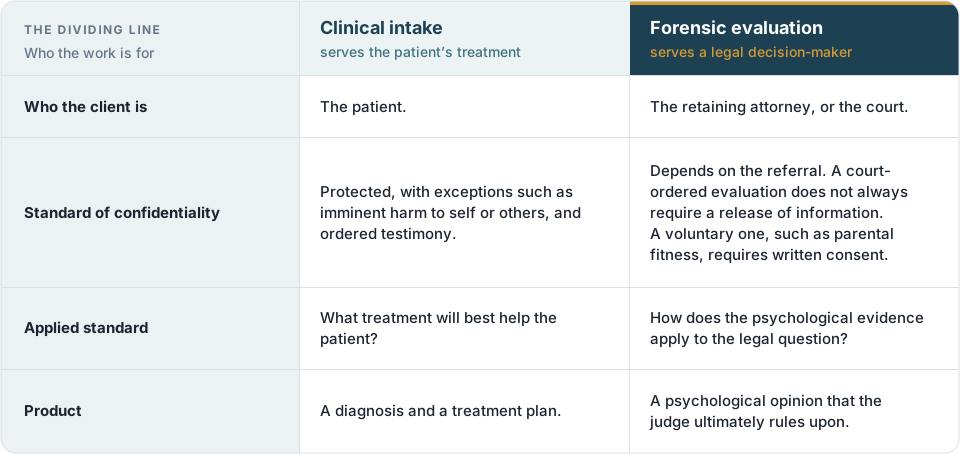
A clinical intake serves the patient's treatment. A forensic evaluation serves the legal decision-maker. That one difference drives every distinction below.
- Who the client is. Clinical: the patient. Forensic: the retaining attorney, or the court.
- Standard of confidentiality. Clinical: protected, with exceptions such as imminent harm to self or others and ordered testimony. Forensic: this depends on the referral. Court-ordered evaluations do not always require a release of information from the person being evaluated, while voluntary evaluations such as parental fitness require written consent before the evaluator can speak with anyone else.
- Applied standard. Clinical: what treatment will best help the patient? Forensic: how does the psychological evidence apply to the legal question?
- Product. Clinical: a diagnosis and a treatment plan. Forensic: a psychological opinion that the judge ultimately rules upon.
Separation of roles is an ethical standard advising against multiple relationships. APA Standard 3.05 bars a psychologist from holding two roles that can harm the person served. Specialty Guideline 4.02.01 warns against therapeutic-forensic role conflicts for treating clinicians asked to serve as forensic examiners.
The practical result: a therapist who has treated your client for two years is a fact witness regarding that treatment, not a neutral evaluator.
What Does a Psychological Assessment Address?
A full psychological evaluation measures functioning in defined areas through a testing battery designed to answer the referral question. A violence risk assessment and a parental fitness evaluation, for example, would likely call for very different batteries.
Cognitive assessments focus on domains such as intelligence, memory, attention, and processing speed. Personality measures are often self-reports completed by the person being evaluated. Those questionnaires can produce data on internalizing and externalizing dysfunction, evidence of thought or personality disorder, and insight into how the examinee views themselves and others. Adaptive and behavioral assessments may be self-report or completed by collateral informants, giving perspective on how the individual navigates their surroundings.
Evaluation of effort and validity should be incorporated throughout. Those tools and techniques are essential to judging whether a statement or a test result is genuine, rather than exaggeration, under-reporting, or feigning. This matters in forensic evaluations, where the context itself can create incentives in either direction, toward exaggeration or toward minimization.
Length depends on a range of factors. A narrow referral, such as whether a person has ADHD, with limited records or collateral contacts, allows a report to be generated more quickly. Cases involving extensive history require more time for review and integration.
Common Legal Applications
Personal Injury and Emotional Damages
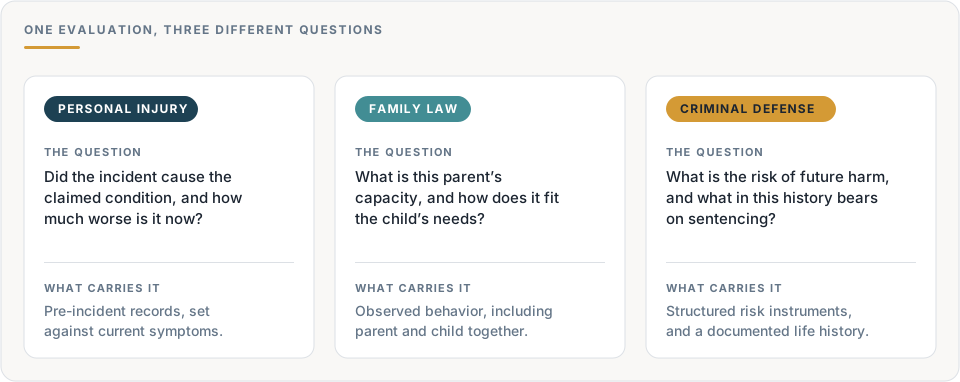
The focus is the cause and severity of trauma-related symptoms. The psychologist engages in extensive record review to disentangle functioning before and after the reported injury. Where a condition predates the injury, the psychological question is whether the injury changed its course or its severity, and by how much. What weight that carries is for the court.
Family Law and Parental Fitness
Custody evaluations look at the parent's capacity, the child's needs, and the fit between them for safety. Observation of the parent-child interaction carries weight alongside interviews with school staff and pediatricians. Courts frown on bare conclusions in this area. Findings tied to specific, observed behavior, supported by testing and relevant history, give the court what it needs for decision-making.
Risk Assessment in Criminal Matters
A violence risk assessment examines the factors that raise or lower the likelihood of future harm, the circumstances under which concern increases, and what can realistically be done to manage it. A psychosexual evaluation is a specialized forensic assessment of sexual behavior, risk, and treatment needs, prepared for use in a legal proceeding.
Both are built on structured instruments with published norms rather than on clinical impression, which is what allows the reasoning to be examined instead of taken on trust.
Mitigation and Sentencing
A mitigation evaluation examines the psychological, developmental, and trauma-related history that bears on how a court sentences a person. The work is historical rather than predictive: it documents what happened and how it shaped functioning, and leaves the weight of that history to the court.
False Confessions and Statement Reliability
This evaluation examines the psychological and situational factors bearing on the reliability of a statement. In many cases the legal issue is not whether a person confessed, but whether the interrogation conditions and the individual's psychological functioning make that confession less reliable than it appears.
Federal Competency and Criminal Responsibility
Competency to stand trial rests on present capacities. The constitutional standard comes from Dusky v. United States (1960): whether the defendant has sufficient present ability to consult with counsel with a reasonable degree of rational understanding, and a rational as well as factual understanding of the proceedings. States articulate it in their own statutes and case law, but the floor is uniform. In practice, the evaluation asks whether mental illness interferes with the defendant's factual and rational appreciation of the legal system and of their own case: whether they can factually understand the charges, the potential penalties, and the adversarial nature of the process, and whether they can conceptualize and apply the weight of the evidence for the purpose of legal decision-making. The psychologist also assesses the capacity to testify relevantly, to consult with counsel, and to remain emotionally and behaviorally controlled in the courtroom.
Criminal responsibility assesses the defendant's mental state at the time of the offense. In many states this is a separate evaluation from competency, because a defendant must be competent in order to enter a plea of not guilty by reason of insanity, diminished capacity, or otherwise.
One scope note, because it decides who should call. This private service is limited to federal matters and is not offered for private state-court competency referrals. Mitigation referrals, unlike criminal responsibility and competency, are accepted in both state and federal matters.
Why Is Psychological Testing Important?
Psychological testing provides standardized information that can support or challenge clinical impressions. In federal court, Daubert v. Merrell Dow Pharmaceuticals (1993) governs the admissibility of expert testimony, and state courts vary in how they apply their own version of Rule 702. Under either, the clinician should select testing that is scientifically valid, reliable, and supported by peer-reviewed research. Such testing generates scores, including standard scores, t-scores, and percentiles, that compare the individual's results with a same-age peer group.
Because forensic reports are subject to scrutiny, standardized testing grounds the reasoning in data another expert can re-score and check. It is equally important to be aware that testing results are not definitive; they are one piece of data. A strong evaluation integrates them with multiple sources of evidence in light of the specific legal question.
From First Call to Final Report
- 1Request a consultation or an evaluation, describing the referral question, the important facts of the case, and the intended deadline.
- 2The initial consultation reviews the order and the expectations for the report, and sets the fee.
- 3The psychologist reviews the available records and requests any further documents needed, such as discovery, a RAP sheet, or jail records.
- 4The fee is set by the scope of the evaluation and is payable before the initial interview or testing session. Fees are never contingent on the findings or on the outcome of the case.
- 5The report is delivered on the agreed date, whatever the findings.
Conclusion
Attorneys asking about the utility of a forensic psychological evaluation usually want to know what weight the document will carry in court. Reports are most helpful when the referral question specifically asks for an assessment of mental health symptoms and their potential influence on the case. They are strongest when the psychologist works from a diverse set of data, such as hospital records, collateral interviews, and testing, to form solid opinions.
Those conditions are set before the assessment begins, and they are far easier to meet when attorneys provide records and contact information up front. A loosely designed evaluation cannot be fixed at deposition.
If your case could benefit from a psychological evaluation, call (801) 758-8074 for a twenty-minute case referral consultation. We will tell you whether your question can be answered, what the battery would likely involve, and what the real timeline looks like before you commit to anything.
If you or your client is in crisis, call or text 988 for the Suicide and Crisis Lifeline in the United States.
Frequently Asked Questions
Can Opposing Counsel Get the Raw Test Data?
Not in the way most lawyers expect, and the distinction matters. Test data, meaning the examinee's responses, the scores, and the evaluator's notes on them, is released pursuant to a valid release or a court order, consistent with APA Ethical Standard 9.04. Test materials, meaning the protocols, manuals, and the items themselves, are protected by copyright and by test security obligations, and are ordinarily released to another qualified psychologist rather than to counsel directly. The usual mechanism is a protective order directing release to the other side's retained expert. Both sides see the report itself, with the scores and the reasoning behind them.
Can I Speak With a Court-Appointed Evaluator Ex Parte?
No. A court-appointed evaluator answers to the court. One-sided contact undercuts the neutrality that justifies the appointment. Put questions in writing with copies to all parties, or raise them through the court. A retained expert is different. That relationship runs through you, and conferring is expected.
How Long Is a Report Current?
It depends on what was measured. Competency is a present-tense finding. It can go stale within months if treatment or medication changes. Cognitive findings after a brain injury last longer once early recovery has passed. As a working rule, ask the evaluator about an update when a report is more than a year old. Often a short re-interview is enough.
What Happens If the Examinee Refuses to Participate?
No one can be forced to participate in testing. The evaluator records the refusal, reports what was observed, and notes what the missing data means for the conclusions. In a court-ordered matter, the refusal itself goes into the record. The court is free to weigh it. Partial cooperation works the same way. Validity measures flag what the results can and cannot support.
Sources and further authority
- Specialty Guidelines for Forensic PsychologyAmerican Psychological Association
- Ethical Principles of Psychologists and Code of Conduct, Standards 3.05, 9.04, and 9.11American Psychological Association
- Dusky v. United States, 362 U.S. 402 (1960)Legal Information Institute, Cornell Law School
- Daubert v. Merrell Dow Pharmaceuticals, Inc., 509 U.S. 579 (1993)Legal Information Institute, Cornell Law School
Related Services
Written by Dr. Meghan Semenick, Licensed Clinical Psychologist : Forensic & Trauma Psychological Services.
All insights